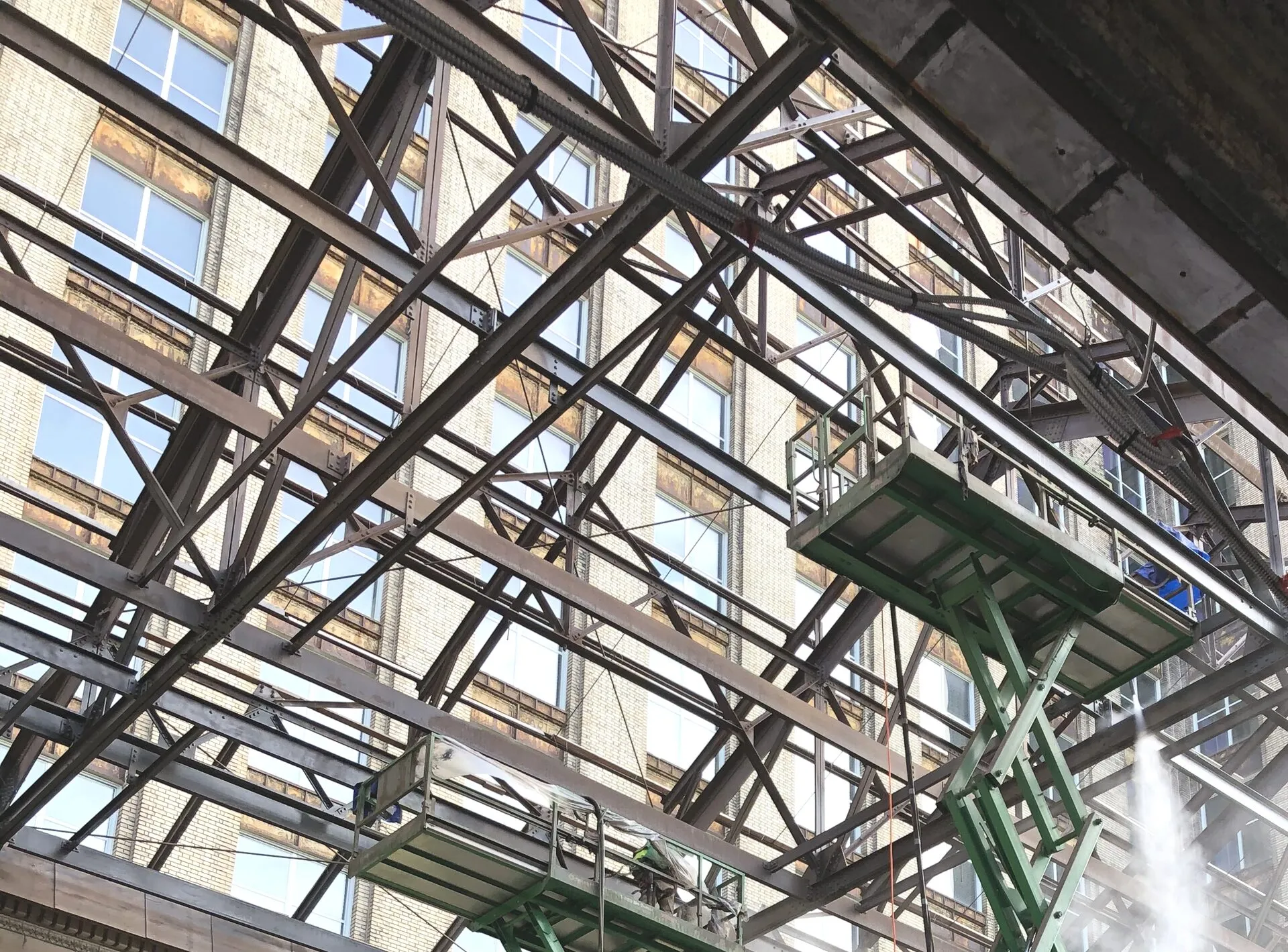
Removing an industrial coating is rarely as simple as slapping on a paint stripper and waiting. Failed epoxy linings, thick build-up from decades of recoating, lead-based paint on structural steel, and chemically resistant coatings on process equipment all require mechanical removal — and the method you choose affects cost, safety, and what your surface looks like when you’re done.
40,000 PSI UHP water blasting removes coatings without introducing any foreign material to the surface. No abrasive. No chemicals. No dust. Here’s why that matters and when it’s the right tool for coating removal work.
How 40,000 PSI Actually Removes a Coating
At 40,000 PSI, water exits a small-diameter nozzle at velocities that generate enough kinetic energy to shear the bond between a coating and its substrate. The water doesn’t cut into the steel or concrete — it attacks the weakest point in the coating system, which is typically the adhesion interface between the coating and the substrate, or between coating layers.
What this means in practice:
- Tightly bonded coatings come off clean. The water finds the failure plane and peels from it, rather than grinding down through the coating the way abrasive media does.
- The substrate is left intact. Steel doesn’t lose material. Concrete doesn’t get micro-fractured. The surface profile from a previous blast is preserved.
- Multiple coating layers are removed in a single pass when they’ve failed at the adhesion layer — the water undercuts the whole build-up.
Coating Types and How Water Blasting Handles Them
Epoxy coatings and linings
Epoxy is one of the most common industrial coating failures. Tank linings, floor coatings, and structural steel epoxies fail from moisture intrusion, chemical exposure, or mechanical damage. Once the adhesion is compromised, 40,000 PSI water blasting strips the failed epoxy efficiently. On thick-film tank linings (40–60 mils), it typically outperforms abrasive blasting in both speed and surface cleanliness — there’s no abrasive residue bonding to the exposed steel.
Lead-based paint
Lead paint on steel structures — bridges, water towers, industrial buildings — is one of the most common coating removal challenges in Michigan. Dry abrasive blasting generates airborne lead dust that requires workers in full PPE, air monitoring, and disposal of lead-contaminated spent media. UHP water blasting keeps everything wet: the removed paint, the dust that would otherwise be airborne, and the contaminated water. Waste is collected and disposed of as hazardous material, but the airborne exposure risk during the work itself is dramatically lower. Many state DOT and EPA specs now require wet methods for lead paint removal.
Zinc-rich primers and anti-corrosion coatings
Zinc-rich primers bond tightly to steel and are designed not to fail. When recoating is needed and the zinc primer is still intact, water blasting can clean the surface — removing loose material, contamination, and any topcoat degradation — without removing the still-functional primer. This extends the service life of the coating system without the cost of full blasting.
Polyurea and polyurethane linings
Thick polyurea and spray polyurethane coatings on secondary containment areas, tanks, and industrial floors can be extremely difficult to remove with abrasive blasting — the elastomeric coating absorbs energy rather than fracturing. UHP water blasting cuts through these coatings more effectively by attacking the adhesion interface rather than trying to abrade through the coating material.
Intumescent fireproofing
Failed or damaged intumescent coatings on structural steel need to come off cleanly without damaging the steel underneath. Water blasting removes softened or delaminated intumescent coating without the impact damage that abrasive blasting can introduce to already-compromised steel.
No Abrasive Residue — Why It Matters
When you abrasive blast a surface and then apply a coating, any abrasive particles left embedded in the surface or accumulated in crevices can create adhesion problems over time. The coating bonds around the particle rather than to the steel, creating a weak point.
Water blasting leaves no foreign material. The surface — whether steel, concrete, or masonry — is exactly what it was under the coating, with no abrasive contamination. For coating systems that specify “no abrasive embedment” in their application data, water blasting is the required method.
This is especially important in:
- Tank interiors where abrasive residue can contaminate the stored product
- Food processing equipment and FDA-regulated storage vessels
- Pharmaceutical and clean-room adjacent facilities
- Medical gas piping and compressed air systems
The Dust-Free Advantage
Industrial coating removal generates dust from the coating itself — lead, chromate pigments, zinc, and other metals in older paint systems. Abrasive blasting takes that dust and disperses it. Water blasting keeps it wet and contained.
Beyond the hazardous material angle, dust-free operation means:
- Other trades can continue working in adjacent areas
- Production doesn’t have to shut down as far from the work
- Sensitive equipment doesn’t need to be sheeted off
- Air quality monitoring requirements are reduced
On active industrial facilities — plants that can’t afford a full shutdown — dust-free coating removal often makes the difference between a job that can be scheduled and one that can’t.
Flash Rust After Coating Removal
The one management challenge with water blasting on steel: flash rust. Bare steel begins oxidizing quickly after water blasting, especially in humid conditions. You have a window — typically a few hours, sometimes less — before surface rust appears.
Managing this means coordinating the blasting and coating schedule tightly, using flash rust inhibitors in the water where the coating spec allows, and specifying a primer that tolerates light flash rust (most industrial primers do, within defined limits in the TDS).
For large jobs, blasting and priming in sections rather than blasting the entire structure before any coating is applied keeps the flash rust window manageable.
When Coating Removal Calls for Water Blasting
Use UHP water blasting for coating removal when:
- Lead paint or heavy metal pigments are in the coating system
- You’re working where dust cannot be tolerated (active facilities, near other trades)
- Abrasive containment over traffic, water, or drainage areas is impractical
- Tank or vessel interiors where abrasive recovery is difficult
- The substrate has an existing anchor profile you want to preserve
- The coating spec prohibits abrasive embedment
Call us for a free estimate — we’ll look at your coating system, substrate, and job site conditions and tell you what makes sense.
Blasting Jack. Michigan-wide mobile operation.