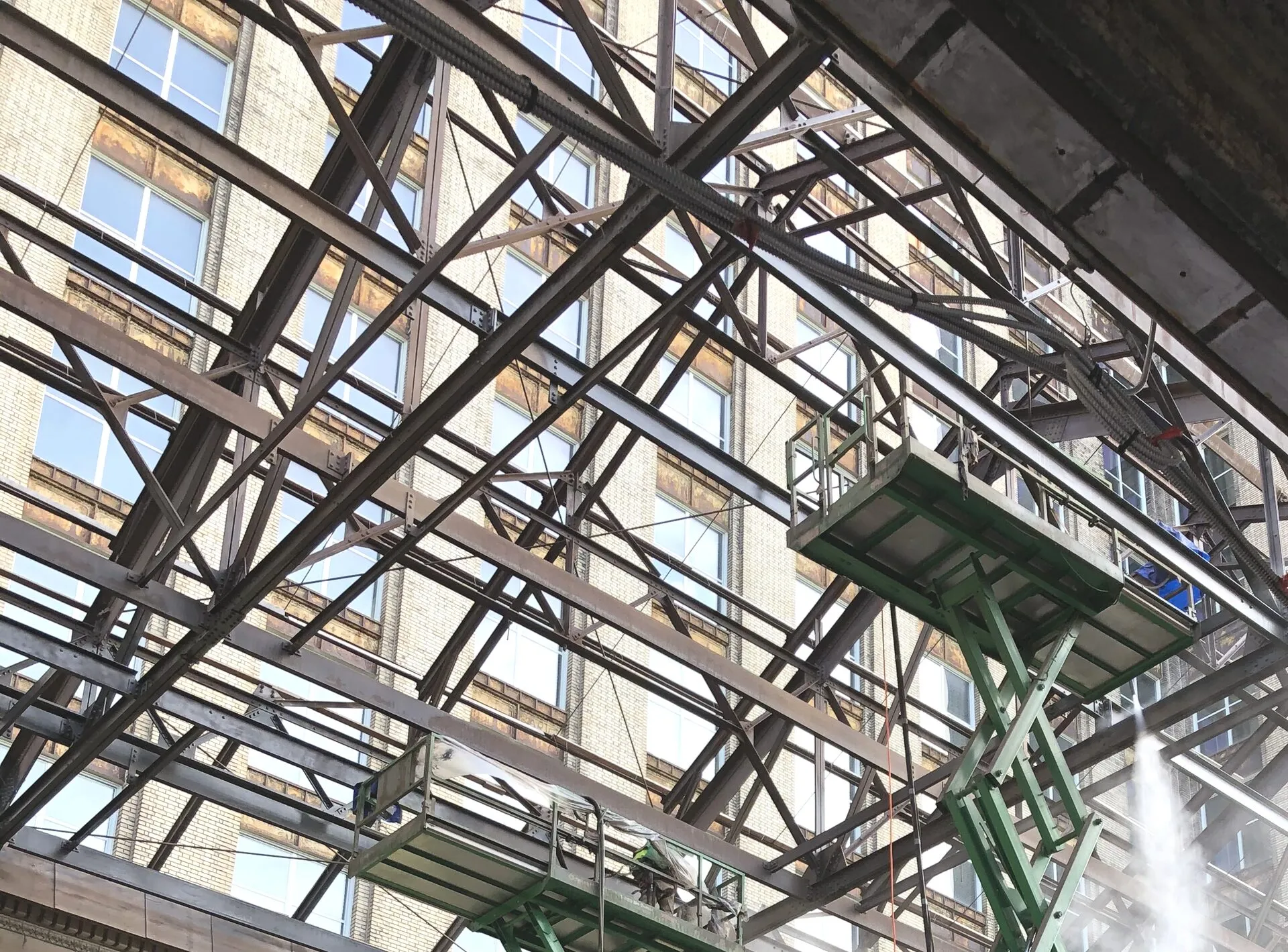
Services
Steel Surface Preparation Contractor
Surface preparation that protects the coating before it starts.
Services
Surface preparation that protects the coating before it starts.
A coating system is only as good as the surface it's applied to. The SSPC estimates that over 80% of industrial coating failures are caused by inadequate surface preparation — not coating quality, not application method, not environmental conditions. Inadequate prep.
The two things abrasive blasting achieves simultaneously are what make it the required prep method for industrial steel: cleanliness (removing rust, mill scale, old coatings, and contaminants) and anchor profile (creating the surface texture that gives coatings mechanical adhesion). A coating applied over contaminated steel or over steel with insufficient profile will fail at the bond line — regardless of coating quality.
Blasting Jack performs steel surface preparation to the SSPC standard specified by the coating system — confirmed before any blasting begins, documented after.
All rust, scale, coatings, and contaminants removed. Required for immersion service, tank linings, and severe environments.
≥95% of surface free of all residues. Required by most high-performance industrial coatings (epoxy, urethane, zinc-rich primers).
≥2/3 of surface free of all residues. Minimum acceptable standard for general industrial coating applications.
Loose rust and scale removed, tight material remains. Limited coating applications — check spec before accepting.
Surface profile — measured in mils (thousandths of an inch) using Testex replica tape — is the peak-to-valley roughness created by abrasive blasting. Coating systems specify a minimum profile to achieve rated adhesion strength.
Too little profile: the coating doesn't have enough surface area to bond and adhesion is insufficient. Too much profile: peaks can telegraph through thin film coatings, creating a path for moisture infiltration.
Media selection, blast pressure, and standoff distance determine the resulting profile. Blasting Jack selects parameters to hit the profile range specified by the coating manufacturer.
Always confirm with the coating manufacturer's PDS — these are representative ranges, not universal specs.
Once steel is blasted to bare metal, it begins oxidizing — the rate depends on humidity, temperature, and steel chemistry. Flash rust can appear within hours in Michigan's summer humidity. Coating should follow blasting as quickly as the spec allows.
We coordinate with coating contractors on sequencing so the window between blast and prime is minimized. This is a critical scheduling variable, not an afterthought.
Many industrial projects require documented evidence of surface prep compliance before coating application is authorized. Blasting Jack provides Testex tape profile documentation and surface cleanliness records on projects where this is required.
Coating inspectors can be coordinated to verify the surface before primer is applied. We work within whatever inspection and documentation framework your project requires.
Sister Brand
Through our sister brand Endurance Painting, Blasting Jack coordinates steel surface preparation and industrial coating application under one project plan. Blasting Jack prepares the surface. Endurance Painting protects the asset.
Request a Blasting + Coating QuoteThe required standard is specified by the coating manufacturer's product data sheet (PDS) and/or the project engineering spec. Most zinc-rich primers and high-performance epoxies require SSPC SP-10 as a minimum. Immersion service coating systems typically require SP-5. If you don't have the PDS, we can help you identify what's required.
Yes. We provide Testex replica tape surface profile readings and visual inspection records when required. We can also work within third-party inspection frameworks specified by the project.
Scheduling. The window between blast completion and primer application should be as short as possible. We coordinate with coating crews on sequencing and can stage blast work in sections to keep that window tight. In high-humidity conditions, inhibitive rinse additives can be applied after blasting.
Yes. We work at fabrication shops regularly — blasting fabricated steel to the required SSPC standard before primer or delivery. Shop blasting is more efficient than field blasting on standard fabricated steel.
Structural steel, fabricated steel assemblies, tanks and vessels, equipment and machinery, trailers, bridges and infrastructure, parking garage steel, and any other ferrous metal surface that requires industrial coating.