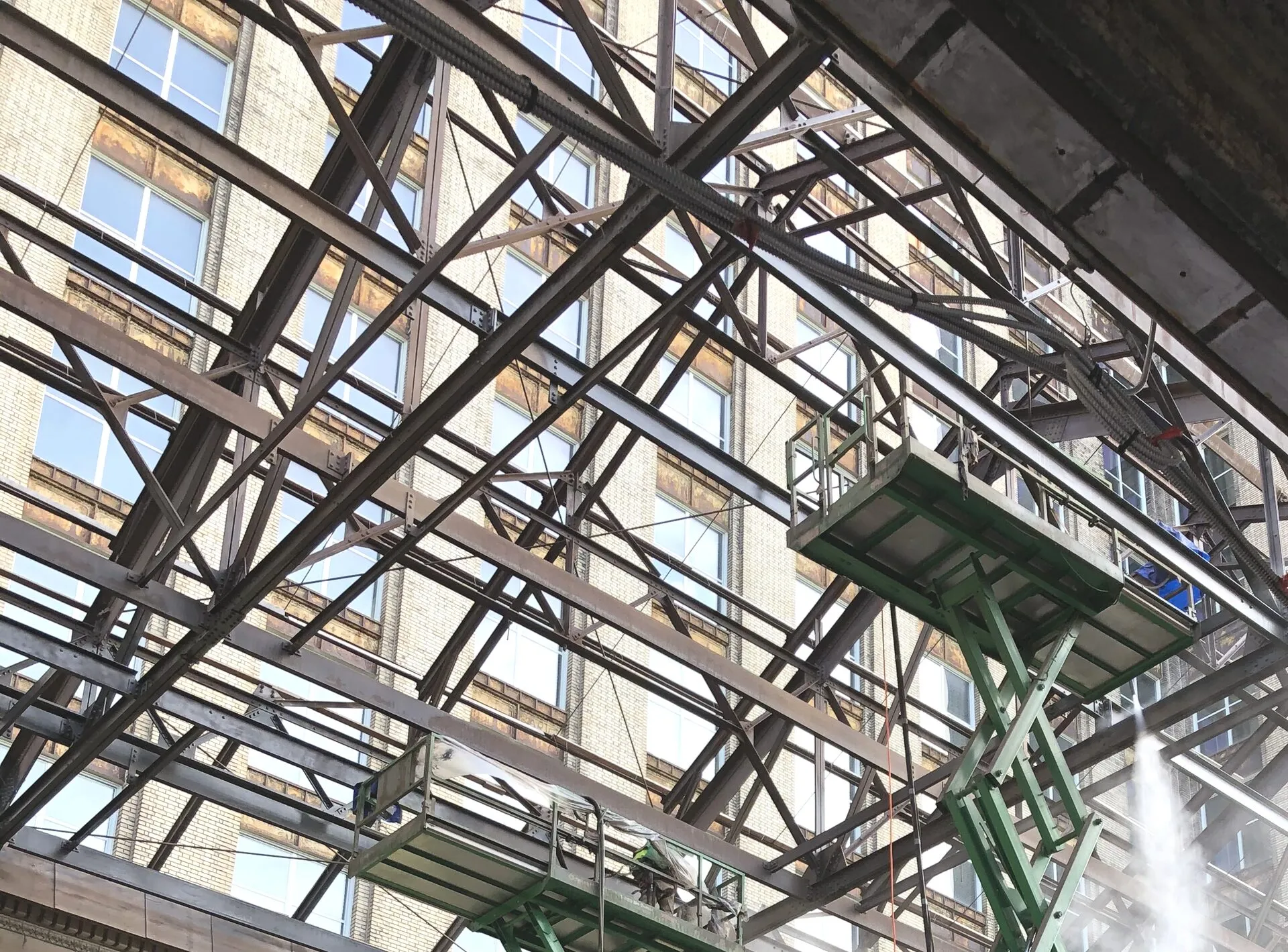
Tank interior surface preparation presents a set of challenges that make UHP water blasting the default choice for anyone who’s done enough tank work to know what a bad outcome looks like. Spent abrasive at the bottom of a vessel that holds food product. Silica dust in an enclosed space with no airflow. A crew trying to vacuum blast in a 6-foot-diameter pipe. All of these are real problems that water blasting sidesteps.
40,000 PSI UHP water blasting drains, doesn’t pile up, and produces no airborne particulate. For tank interiors, vessels, and confined space work, those two properties change the entire job.
Why Abrasive Blasting Is Difficult in Tanks
Abrasive blasting inside a tank creates several problems that are manageable in open environments but serious in enclosed ones:
Media recovery. Spent abrasive has to come out before the new lining goes on. In a large tank with flat floor sections, this means vacuuming or shoveling media out — a time-consuming step that follows the blasting work and often takes longer than the blasting itself.
Dust concentration. An enclosed tank with abrasive blasting in progress fills with silica dust rapidly. Even with supplied-air respirators, visibility drops to near-zero, work has to pause for air changes, and the dust settles on the freshly blasted surface before it can be primed.
Abrasive contamination. In food-grade silos, chemical storage vessels, and potable water tanks, abrasive media left behind is a contamination problem. Complete abrasive removal from a large vessel requires verification — and any media missed becomes a defect in the new lining.
Confined space entry. Abrasive blasting in a confined space requires continuous air monitoring, supplied air for the operator, and atmospheric testing after blasting before anyone else enters. All of this is required for water blasting too, but the absence of dust makes the confined space atmospheric conditions significantly easier to manage.
How Water Blasting Works in Tank Interiors
At 40,000 PSI, the water jet removes coatings, scale, and corrosion from the tank walls, floor, and ceiling while the removed material drains to low points. Portable submersible pumps remove water and debris from sumps or low points as the work progresses.
Waste water management is the primary logistics element. Water and removed material (coating, rust, sludge) are collected at the sump, pumped to a holding container, and disposed of as regulated waste if the removed material contains lead, heavy metals, or other hazardous content. The volume is predictable and containable — unlike abrasive media, which spreads throughout the vessel.
Access inside tanks typically uses the same entry points as abrasive blasting — manholes, nozzle openings, or temporary access cuts. The equipment is similar: a high-pressure hose, a lance, and nozzle head. Operators work from within the tank for vertical and overhead surfaces.
Types of Tanks and Vessels
Above-Ground Storage Tanks (ASTs)
Petroleum and chemical ASTs require periodic lining inspection and relining. Water blasting removes the old lining, rust scale from the tank floor and walls, and any product contamination — leaving a clean substrate for the new lining system. Because there’s no abrasive media to recover, a single crew can often complete a tank interior in a fraction of the time abrasive blasting would take.
Potable Water and Wastewater Tanks
Water and wastewater tanks have strict requirements about contamination. Abrasive blasting introduces a foreign material that must be completely recovered. Water blasting adds no foreign material — the only waste is the removed coating and corrosion products mixed with the water. For tanks going back into potable water service, this is a significant advantage.
Food-Grade Silos and Hoppers
FDA-regulated and food-grade storage vessels — flour silos, sugar hoppers, grain storage — cannot tolerate abrasive contamination. We blasted and relined a food-grade storage silo in Michigan using water blasting specifically because abrasive media in a food storage vessel wasn’t an option. Water removed the failed interior coating cleanly, the silo was flushed and dried, and the new FDA-compliant lining went on.
Chemical Process Vessels
Reactors, mixing tanks, and process vessels in chemical and pharmaceutical facilities have process purity requirements that make abrasive contamination unacceptable. Water blasting removes failed internal coatings and corrosion products without introducing abrasive media into the vessel interior.
Underground Storage Tanks (USTs)
Underground petroleum storage tanks have limited access and tight interior dimensions. Water blasting’s ability to operate through small access openings and drain naturally makes it practical in geometries where abrasive recovery would be extremely difficult.
Confined Space Safety Considerations
Water blasting in confined spaces requires the same confined space entry protocols as abrasive blasting — atmospheric testing, continuous monitoring, attendant outside the space, rescue procedures, permit documentation. Water blasting doesn’t eliminate confined space hazards; it changes the hazard profile.
Slip and fall risk. Water blasting creates wet, slippery surfaces inside the tank. Workers need appropriate footwear and fall protection where heights are a factor.
Oxygen displacement. In tanks that previously stored fuels or chemicals, residual vapors must be cleared and monitored continuously. Water blasting doesn’t add oxygen displacement risk beyond what the tank itself presents.
Noise. A 40,000 PSI pump and lance in an enclosed tank generates significant noise. Hearing protection is required.
High-pressure injection hazard. The water jet at 40,000 PSI can cause serious injury if it contacts skin. Operators need full PPE including high-pressure rated protective clothing, and non-essential personnel must stay clear of the work area.
After Blasting: Flash Rust and Primer Timing
Bare steel inside a tank after water blasting begins flash rusting within hours. The enclosed environment of a tank — often with trapped moisture — can accelerate this. Coordinating blasting and lining application requires:
- Blasting and priming in sections so the flash rust window is manageable
- Active drying with dehumidification or forced air between blast and prime
- Using primers rated for light flash rust per the lining manufacturer’s TDS
- Scheduling blasting and lining application as close together as possible
Most industrial tank lining systems specify acceptable flash rust levels. Working within that spec is a coordination problem — not a reason to choose abrasive blasting, which has its own flash rust exposure window on steel surfaces.
Blasting Jack has blasted and prepped tank interiors for lining work across Michigan — above-ground petroleum tanks, wastewater vessels, food-grade silos, and industrial process equipment. If you’re planning a tank relining project and want to know whether water blasting or abrasive blasting makes more sense for your vessel, give us a call. Free estimates.