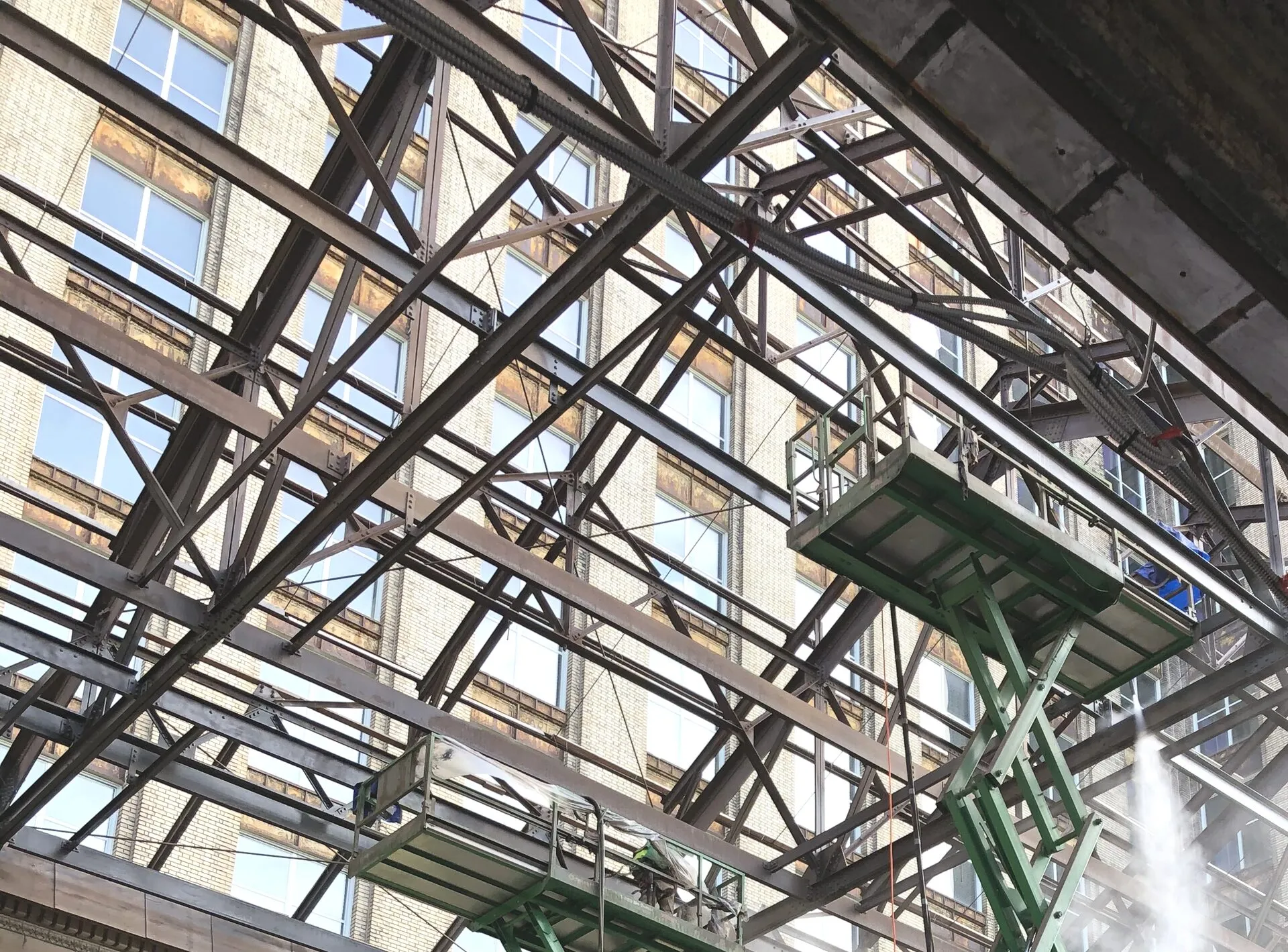
When an industrial coating system fails before its expected service life — blistering after one season, delaminating in sheets, rust bleeding through a two-year-old topcoat — the instinct is to question the product. Bad batch, wrong formulation, application error. In most cases, that instinct is wrong.
The SSPC: The Society for Protective Coatings has documented for decades that surface preparation failures account for the majority of premature industrial coating failures. The coating didn’t fail because the product was defective. It failed because the steel underneath wasn’t properly prepared before the coating went on.
Understanding the failure mechanisms makes it clear why surface preparation is not a place to reduce cost or schedule pressure.
The Five Primary Causes of Industrial Coating Failure
1. Inadequate Surface Cleanliness
Every industrial coating system has a minimum surface cleanliness requirement specified by the manufacturer — typically expressed as an SSPC surface preparation standard. SSPC-SP 6 (Commercial Blast) leaves up to one-third of the surface area with residual rust, mill scale, or staining. SSPC-SP 10 (Near-White Metal Blast) allows no more than 5% of the surface area with light staining. SSPC-SP 5 (White Metal Blast) requires a completely clean surface with no visible contamination.
These are not arbitrary designations. High-performance coatings — epoxy mastics, zinc-rich primers, urethane topcoats — are formulated to bond to steel at a specific cleanliness level. When that level isn’t met, the coating bonds to the contamination layer rather than to the steel. Residual rust and mill scale are mechanically weak. As the contamination continues to oxidize under the coating film, the bond breaks and the coating lifts.
The failure timeline depends on how far below the spec the surface prep fell and what the service environment looks like. In an immersion or splash zone environment — a tank interior, a seawall, a parking structure in a road salt environment — inadequate surface cleanliness can produce visible failure within one season. In a sheltered interior environment, it may take three to five years, but the failure is coming.
2. Incorrect Anchor Profile
Surface cleanliness and anchor profile are separate requirements. A surface can be blasted clean to SP 10 standards and still fail if the profile — the microscopic peaks and valleys left by the abrasive — is outside the range the coating requires.
Anchor profile is measured in mils using replica tape (Testex Press-O-Film) or a surface profile gauge, and reported as a range. A high-build epoxy mastic may require a 2.5 to 4 mil profile. A zinc-rich primer may require 1.5 to 3 mils. Applying a coating over a profile that’s too shallow means insufficient mechanical surface area for adhesion. Too deep, and the peaks stand above the coating film — those exposed high points begin to rust through immediately regardless of what’s applied over the valleys.
Profile is controlled by abrasive selection and blast parameters. Coarse abrasive at high pressure cuts deeper. Fine abrasive at lower pressure produces a shallower profile. Contractors who use whatever abrasive is cheapest or on hand, without regard for the coating spec, routinely produce profiles that are outside the manufacturer’s requirement. The coating fails on their schedule, not yours.
3. Surface Contamination
Visible contamination — rust, mill scale, old coating — is removed by blasting. Invisible contamination is the failure mechanism that’s harder to catch and more damaging when missed.
Soluble salts. Chlorides, sulfates, and nitrates on steel surfaces are not removed by abrasive blasting. These soluble salts draw moisture through the coating film by osmotic pressure, producing blistering that appears to originate from beneath the coating without any visible rust at the blister location. On steel with a history of outdoor or marine exposure, soluble salt contamination is common. Conductivity testing (Bresle patch method or similar) before coating application identifies whether salt levels are within acceptable limits. Exceeding those limits without surface washing first is a guaranteed premature failure.
Oil and grease. Mechanical equipment, manufacturing floors, and industrial surfaces often have hydrocarbon contamination from lubricants and process fluids. Abrasive blasting does not remove oil — it embeds it into the anchor profile. Coating applied over even trace oil contamination has no adhesion to the steel beneath the contamination layer. Solvent wiping before blasting is required on any surface with oil or grease history.
Moisture. Coating applied to steel that’s below the dew point will fail. Moisture condensing on steel between blast completion and primer application is a common failure mechanism on outdoor work where temperature and humidity change through the day. The blasted steel must be above the dew point at the time of coating application — not just when the crew arrives in the morning.
4. Overcoating Failures
Overcoating — applying new coating over existing coating without blasting back to bare metal — is a cost reduction strategy that fails predictably on degraded surfaces.
Overcoating has legitimate applications: applying a topcoat over a sound primer system, adding a maintenance coat over an intact and adherent existing coating. It does not work when the existing coating has lost adhesion, is failing at the interface with the steel, or has been undercut by corrosion. In those conditions, the new coating system bonds to a substrate that is already separating from the steel. The new system fails on the timeline of the existing coating’s final failure — which is accelerated.
The diagnostic test for overcoating suitability is adhesion testing on the existing coating (ASTM D3359 cross-cut or pull-off test). If the existing coating fails cohesively at values below the threshold the new system requires, the surface must be blasted to bare metal before recoating. There is no shortcut.
5. Application Outside Environmental Limits
Even on a properly prepared surface, coating application outside the manufacturer’s environmental limits produces failure. Most industrial coatings specify:
- Minimum and maximum steel temperature at application
- Minimum and maximum ambient temperature
- Maximum relative humidity (typically 85%)
- Minimum temperature above dew point (typically 5°F)
Applying at temperatures below the minimum cure temperature produces undercure — the coating film never fully cross-links and remains soft, porous, and mechanically weak. Applying in high humidity with steel near or below the dew point produces adhesion failure at the steel interface. These failures are not visible at the time of application. They appear over the first service season.
What Proper Surface Preparation Prevents
A properly blasted surface — correct SSPC cleanliness grade, correct anchor profile, no soluble salt contamination above threshold, no oil or moisture — is not a guarantee that a coating will never fail. But it eliminates the failure modes that account for the majority of premature failures in industrial service.
The cost of proper surface preparation on a manufacturing plant, a storage tank, or a commercial building steel project is a fraction of the cost of a coating failure — the reblast, the recoat, the production downtime, and the corrosion repair if the steel has section loss by the time the failure is addressed.
Surface preparation is not a cost center. It’s the foundation the rest of the coating investment depends on.
Blasting Jack provides industrial surface preparation to SSPC standards throughout Southeast Michigan. If you’re evaluating a maintenance recoat project or dealing with a coating failure on a facility asset, contact us to discuss the scope.