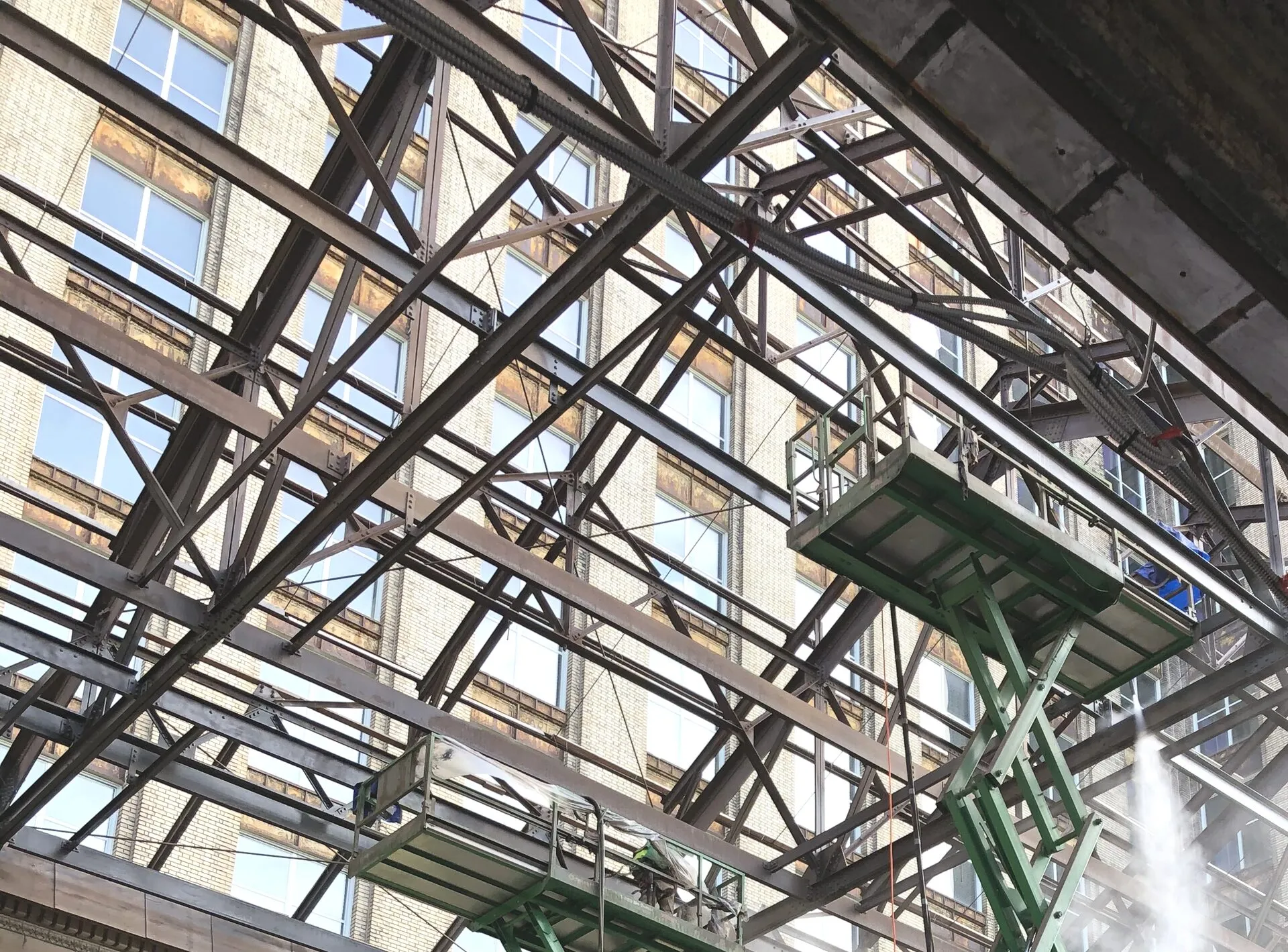
Tank and vessel recoating is among the most demanding surface preparation work in industrial maintenance. The coating systems used in tank interiors — immersion-service epoxies, coal tar epoxies, zinc-rich primers, polyurethane linings — are engineered for aggressive service conditions. They perform as specified only when the substrate they’re applied to has been prepared to the surface cleanliness and profile that the coating manufacturer requires. Cut corners on tank preparation and the lining fails in service, often catastrophically: pinhole corrosion through a failed immersion coating, blistering that contaminates tank contents, or rapid corrosion progression that damages the steel structure itself.
This post covers what proper tank and vessel surface preparation requires — the SSPC standards that apply, the coating system considerations that drive those requirements, and how to plan the downtime window to get the work done right.
Why Tank Preparation Requirements Are More Demanding
Storage tanks, process vessels, and industrial silos face surface conditions that make coating performance requirements more stringent than most other steel assets:
Continuous immersion. Tank interiors store liquids — water, fuel, chemicals, food products, industrial process fluids — that are in continuous contact with the coated steel. Coatings in immersion service cannot tolerate adhesion deficiencies that a coating in atmospheric service might survive. Any area where coating has inadequate bond to steel will blister, undercut, and fail rapidly once immersed.
Coating failure has direct operational consequences. A failing coating on a building’s structural steel is a maintenance problem. A failing coating inside a water storage tank is a contamination problem. A failing lining in a fuel storage tank is a contamination and regulatory problem. Tank coating failure typically requires the tank to be taken out of service, emptied, cleaned, and recoated — a far more disruptive and expensive event than the original maintenance would have been.
Interior access is limited. Once a tank is in service, the coating system is working in conditions that can’t be monitored without taking the tank offline. Unlike building steel where you can see corrosion developing from a distance, tank interior corrosion is invisible until the tank is emptied and inspected. This makes the quality of the initial preparation and coating application the primary determinant of lining service life.
SSPC Standards for Tank and Vessel Work
The applicable SSPC surface preparation standards for tank and vessel work depend on the coating system being applied and the service environment of the tank:
SSPC-SP 5 / NACE No. 1 — White Metal Blast Cleaning. The most demanding standard: no visible rust, mill scale, coating, or contamination on the blasted surface. Required for tank interiors in aggressive chemical service, for potable water tanks, and by many high-performance immersion-grade coating manufacturers. White metal blast is the starting point for any tank coating system with a manufacturer warranty in immersion service.
SSPC-SP 10 / NACE No. 2 — Near-White Metal Blast Cleaning. Allows no more than 5% of the surface area to have light staining from rust or mill scale in the form of streaks and spots. Accepted by most epoxy mastic and high-build barrier coating manufacturers for immersion service. Faster to achieve than SP 5 and acceptable for many industrial storage applications.
SSPC-SP 6 / NACE No. 3 — Commercial Blast Cleaning. Allows residual rust and mill scale on up to one-third of the surface. Appropriate for atmospheric service coating on the exterior of tanks and vessels, but generally not acceptable for immersion service interior coatings. Contractors who propose SP 6 for a tank interior recoat are proposing an inadequate specification.
SSPC-SP 12 / NACE No. 5 — Surface Preparation and Cleaning of Metals by Waterjetting. Ultra-high pressure waterjetting (UHP, typically 25,000+ PSI) to achieve the equivalent of visual cleanliness standards. Used in tank applications where abrasive media contamination of the tank interior or the product it stores is a concern. Does not produce an anchor profile — waterjetting is often followed by abrasive blasting to establish profile, or used with coatings that don’t require a mechanical profile.
Anchor Profile for Tank Coatings
Tank coating manufacturers specify anchor profile requirements as carefully as cleanliness requirements, and for the same reason: mechanical adhesion depends on the coating interlocking with the microscopic peaks and valleys of the blasted surface.
Typical anchor profile requirements for tank and vessel coating systems:
- Zinc-rich primers: 1.5 to 3.0 mils
- High-build epoxy mastics: 2.5 to 4.0 mils
- Coal tar epoxy: 2.0 to 4.0 mils
- Polyurethane topcoats: dependent on primer system beneath
Profile is measured using Testex Press-O-Film replica tape per ASTM D4417 Method C, or with a surface profile gauge. Measurements should be taken across representative areas of the tank interior and documented before coating begins. This documentation protects the coating contractor’s warranty position and gives the facility owner evidence that the preparation met specification.
Abrasive selection controls profile depth. Coarse steel grit or angular slag abrasive at appropriate blast pressure produces profiles in the 3 to 4 mil range. Finer abrasive at lower pressure produces shallower profiles. The blast contractor must know what profile the coating spec requires and select abrasive and parameters accordingly — not use whatever’s available.
Coating System Selection by Zone
Tank interiors have distinct exposure zones that require different coating approaches:
Bottom and lower shell — continuous immersion zone. In contact with liquid at all times when the tank is in service. Requires coating systems rated for continuous immersion at the tank’s operating temperature and with the stored product. For water storage, NSF/ANSI 61 certification is required for coatings in contact with potable water. For fuel storage, coating compatibility with the specific fuel type must be verified.
Upper shell and roof — vapor zone. In contact with product vapor rather than liquid. Vapor zone coatings may differ from immersion zone coatings because the exposure conditions are different — typically less severe than continuous immersion but more variable depending on what’s stored.
Floor — immersion plus potential for standing water, sediment, and microbiological activity. Often the most aggressive zone. Tank floor coatings must handle immersion plus any abrasion from sediment, foot traffic during maintenance, and potential MIC (microbiologically influenced corrosion) in tanks that hold water or water-contaminated fluids.
Exterior — atmospheric service. Tank exterior coatings are atmospheric service applications — less demanding than immersion service coatings but still subject to temperature cycling, UV exposure, and whatever the operating environment creates. Exterior prep requirements are typically SP 6 to SP 10 depending on the coating system.
Managing the Downtime Window
Tank surface preparation and coating work requires the tank to be out of service. For facilities with limited tank redundancy, that downtime is expensive and must be managed tightly. Planning the blast and coat sequence to minimize downtime without compromising coating quality requires understanding the critical path:
Tank cleaning and degassing. Before any blasting work begins, the tank must be cleaned, purged of product vapors, tested for flammable and toxic atmosphere, and issued a confined space entry permit. For fuel tanks, this process takes days. Compressing the cleaning and degassing schedule to save time creates safety and contamination hazards.
Blasting and coating sequence. The blast-to-coat window — the time between surface preparation and primer application — must be minimized. Freshly blasted steel in a humid environment begins to flash rust within hours. In a tank interior where humidity is elevated from residual cleaning water vapor, the window can be shorter than on an exterior job. The blast crew and coating crew should be coordinated to prime the same day as blast completion.
Cure time. High-performance tank lining systems require full cure before the tank is returned to service. Cure time depends on the coating system, film thickness, and temperature during cure. Epoxy systems typically require 7 to 14 days at 70°F for full cure before immersion service. Cutting the cure period short to return the tank to service is a coating failure risk.
Holiday testing. Before the tank is returned to service, the coating film should be tested for pinholes and discontinuities using a holiday detector (spark tester). Any holidays — points where the electrical circuit completes through a coating defect — are repaired before flooding. A tank returned to service with undetected holidays will fail at those points under immersion conditions.
What to Look For When Hiring a Tank Blasting Contractor
For tank and vessel work specifically:
- Confined space entry certification. Tank interior work is confined space work under OSHA 29 CFR 1910.146. The contractor must have a written confined space program, trained entrants and attendants, and a rescue plan.
- SSPC cleanliness grade and profile specification. The contractor should quote the specific SSPC standard they’ll achieve, not “sandblast the interior.”
- Profile measurement and documentation. Ask whether profile will be measured and documented before coating proceeds.
- Blast-to-coat coordination. How the blast crew and coating crew will be coordinated to minimize the window between surface preparation and primer application.
- Waste media handling. How spent abrasive will be removed from the tank interior and disposed of, including TCLP testing if there’s any lead paint history.
Tank work done correctly lasts a decade or more. Done incorrectly, it fails in service and the cost of the second project is the cost of the first project plus the cost of the damage that occurred in between.
Blasting Jack provides tank and vessel surface preparation throughout Southeast Michigan — manufacturing facilities, water infrastructure, industrial process tanks, and agricultural silos. Contact us to discuss SSPC surface preparation for your next tank maintenance project.